
Short answer first. In our database of 798 US doctoral programs, 438 publish a stipend, and the 265 that publish a 12 month figure have a median of 40,000 dollars a year. The middle half of those programs pays between 34,000 and 47,137 dollars. That is the honest shape of a PhD stipend in the USA: not one national number, but a band, and your offer will land somewhere inside it depending on your field, your university, and the city you have to live in.
What a PhD stipend actually is
A stipend is the living allowance a program pays you while you train. It is normally paid monthly or twice a month, and it is separate from the other two parts of a funded offer. The tuition waiver covers your tuition bill. The health insurance subsidy covers some or all of your insurance premium. The stipend is the part you actually live on: rent, food, transport, and everything else. Comparing offers by the stipend alone is the most common mistake applicants make, because two offers with the same stipend can include very different tuition and insurance terms.
The benchmark rates behind the band
The band is not random. Departments set stipends against published federal rates, and two of them anchor the whole market.
| Benchmark | Annual rate | What it tells you |
|---|---|---|
| NIH Kirschstein-NRSA predoctoral rate, fiscal year 2026 | $29,364 | The federal training rate for predoctoral fellows. Widely treated as the floor in the biomedical and health sciences. |
| NSF Graduate Research Fellowship | $37,000, plus a $16,000 tuition allowance | The national merit fellowship rate. A strong offer in most fields approaches it or beats it. |
| Median published 12 month stipend, our database | $40,000 | The middle of the 265 programs that publish a 12 month figure, across 100 universities. |
| Top quarter of published 12 month stipends | $47,137 and up | Where the best phd stipends sit before cost of living is considered. |
Read against those anchors, our data says 60 percent of published 12 month stipends sit at or above the NSF fellowship rate of 37,000 dollars, and about 11 percent sit below the NIH floor of 29,364 dollars. If an offer lands below the NIH rate, that is worth a direct question to the program, because the federal government itself pays its own trainees more.
The 9 month trap inside the same band
Not every published figure covers 12 months. Another 173 programs in our database publish only a 9 month, academic year figure, with a median of 29,192 dollars. A 9 month stipend and a 12 month stipend are not the same offer at the same number: the 9 month student has to fund the summer from savings, a summer job, or separate summer funding. Before you compare any two offers, get the appointment length in months, in writing. It changes the monthly maths more than most differences in the headline number.
Why two offers in the same field can differ by 15,000 dollars
Funding mechanism. Research assistantships are paid from a professor's grant and tend to track the grant's pay scale. Teaching assistantships are paid from a departmental teaching budget and tend to sit lower and move slower. Fellowships sit at the top because they are merit awards with no work obligation attached.
Public and private budgets. Private research universities with large endowments often pay above nearby public universities in the same field, although well funded public flagships close much of the gap. The spread inside one field is wide enough that the university matters as much as the discipline.
Cost of living. Programs in expensive cities pay more on paper because they have to. Whether they pay enough more is a separate question, and it is the question that decides your next five years.
The test that beats comparing raw numbers
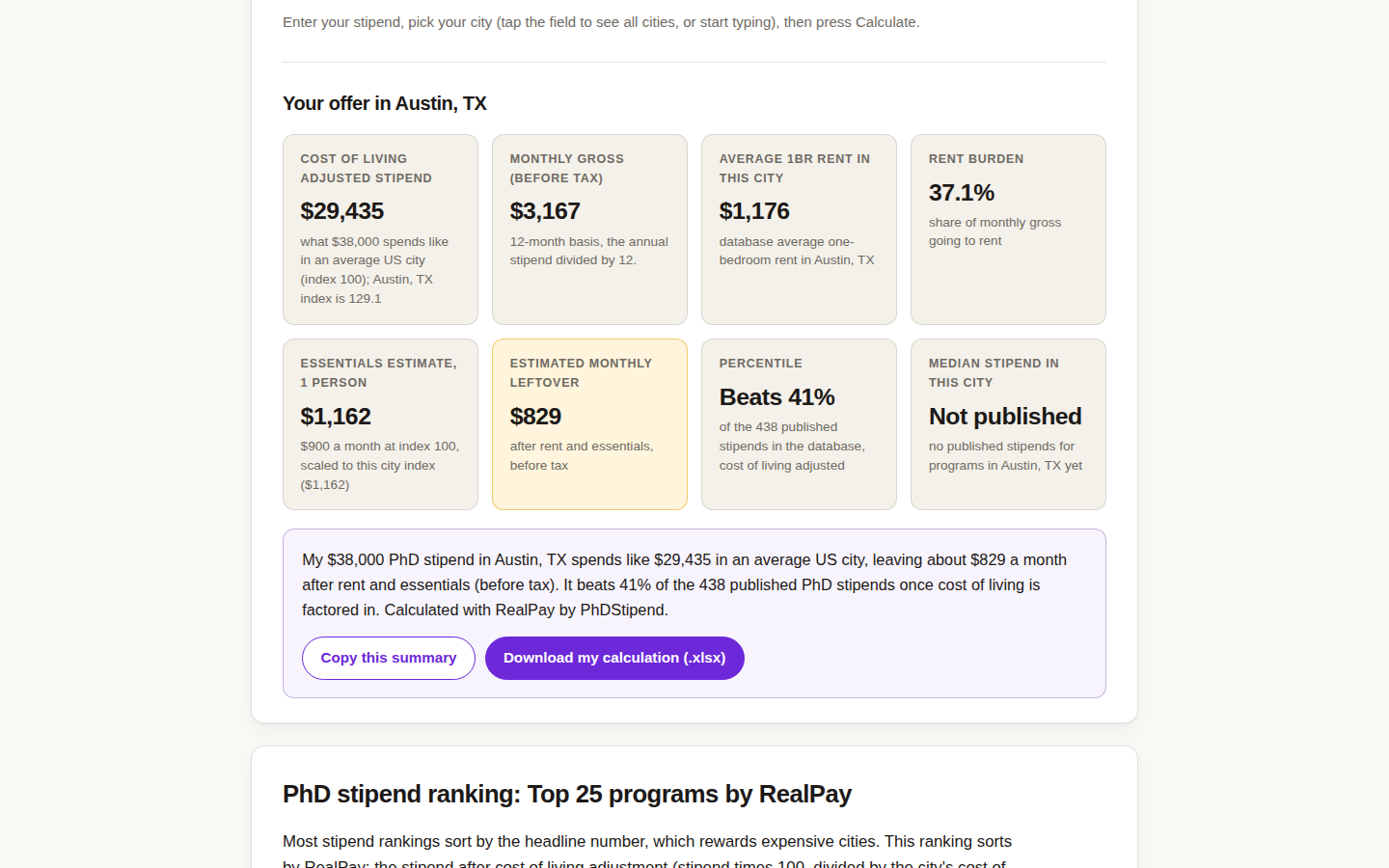
Divide the annual stipend by 12, then set the average one bedroom rent for the city against that monthly figure. If rent takes more than half of the gross monthly stipend, the rest of the budget is tight before tax, fees, and food enter the picture. Our cost of living adjusted stipend ranking runs that test across every city in the database, and the RealPay Calculator runs it for one specific offer, with the full cost of living adjustment and a percentile against all 438 published stipends.
An offer checklist, in the order to ask
- Appointment length. Nine, ten, or twelve months, and what happens in the summer.
- What sits on top of the stipend. Tuition waiver in full or in part, mandatory fees, and how much of the health insurance premium the program covers.
- Years guaranteed. Of the programs in our database that state a funding guarantee, 105 guarantee five years. Ask how many years your letter guarantees, not just what year one pays.
- Work attached. Where teaching is recorded in our data, the median load is 20 hours a week. Confirm the cap in your letter.
Every program in this article can be looked up in our searchable database of 798 programs, with the published stipend, the funding years, and the city rent side by side. If you hold two offers and want a second pair of eyes on the maths, send them over and we will compare them honestly.
Sources: NIH Kirschstein-NRSA fiscal year 2026 predoctoral rate (29,364 dollars); NSF Graduate Research Fellowship rate (37,000 dollars plus a 16,000 dollar tuition allowance). Stipend and rent figures: the PhDStipend database of 798 programs at 100 universities, of which 438 publish a stipend (265 publish a 12 month figure and 173 publish only a 9 month figure). Rents are recorded city averages for a one bedroom home.